JPods Logo
clouds

Make Transport Faster

On-demand, non-stop mobility regardless of age, ability or wealth.

Make Transport Affordable

Control gas prices.

Make Transport Safer

Morgantown's PRT has delivered 110 million injury-free passenger miles.

Make Transport Cleaner

Clean by not wasting 80% of energy.

Make Transport Cleaner

Clean by not wasting 80% of energy.

Make Transport Safer

Cut energy needs by 90%. Then solar can power transport.

Network Examples

Specific JPods Proposals

Station Design

Specific JPods Proposals

Horizontal-Elevators

Solving access problems.

JPods Demo Truss

Solving access problems.

JPod Truss

First JPods vehicle with fourth generation truss.

  • Effet du soleil
  • Eden
  • Snail on the Corn
  • Flowers
  • Flowers
  • Alone Beach
  • Proposals
  • Stations
  • Rescue-Rail
  • Rescue-Rail
  • Horizontal-Elevators
  • JPod Truss
  • JPod Truss

Action:
Create an economic boom by setting a Performance Standard of 300 watt-hours per passenger-miles (114 miles per gallon) and granting rights of way to anyone willing to risk private capital to build solutions that exceed that standard. Change the lifeblood of our economy from oil to ingenuity.

Background:
Mobilizing to fight World War I, communications, transportation and power infrastructure were socialized. Policy makers and bureaucracies implemented central planning and institutionalized the great innovations at that time of Ford, Edison, Bell and the Wright Brothers. For a century there has been virtually no innovation as measured by:

  • Congestion has increased to costs each American about $434 a year.
  • Accidents now cost each American about $1,051 per year. We may have gotten better at surviving car crashes, but not at avoiding them.
  • Dependence on oil has created a monolithic addiction and setup a potential Potato Famine event.
  • Dependence on imported oil has forced debt that grows at about $600 billion a year.
  • Efficiencies are unchanged since the Model-T creating two Civilization Killers:
    • Peak Oil: Geology limits how fast oil can be extracted. World Crude Oil Production peaked in 2005 at about 74 mbd and will begin a ruthless decline no later than 2012.
      • Gas prices per family per year increased by $2,000 between 2002 and 2006 forcing in more and more families to choose between paying for commutes and mortgages.
      • Enough mortgage payments were missed to collapse the banking system.
      • Without disposable income, more and more jobs are being lost.
      • Efforts to sustain access to oil will cost $27-57 trillion between now and 2020.
    • Global Warming: Life requires balance.
      • Food is good, but diets are out of balance have created an obesity and diabetes epidemic in the US. In the same way, out of balance consumption of oil/coal and the associated waste create risks. There is no need for scientific proof that wasteful behavior and careless discarding of waste, gluttony and sloth, are morally repugnant in their fundamental nature. Stewardship and sound ethics compel conservation and innovation currently stifled by central planning.
      • Population growth without efficiency growth is exhausting the Earth's resources.

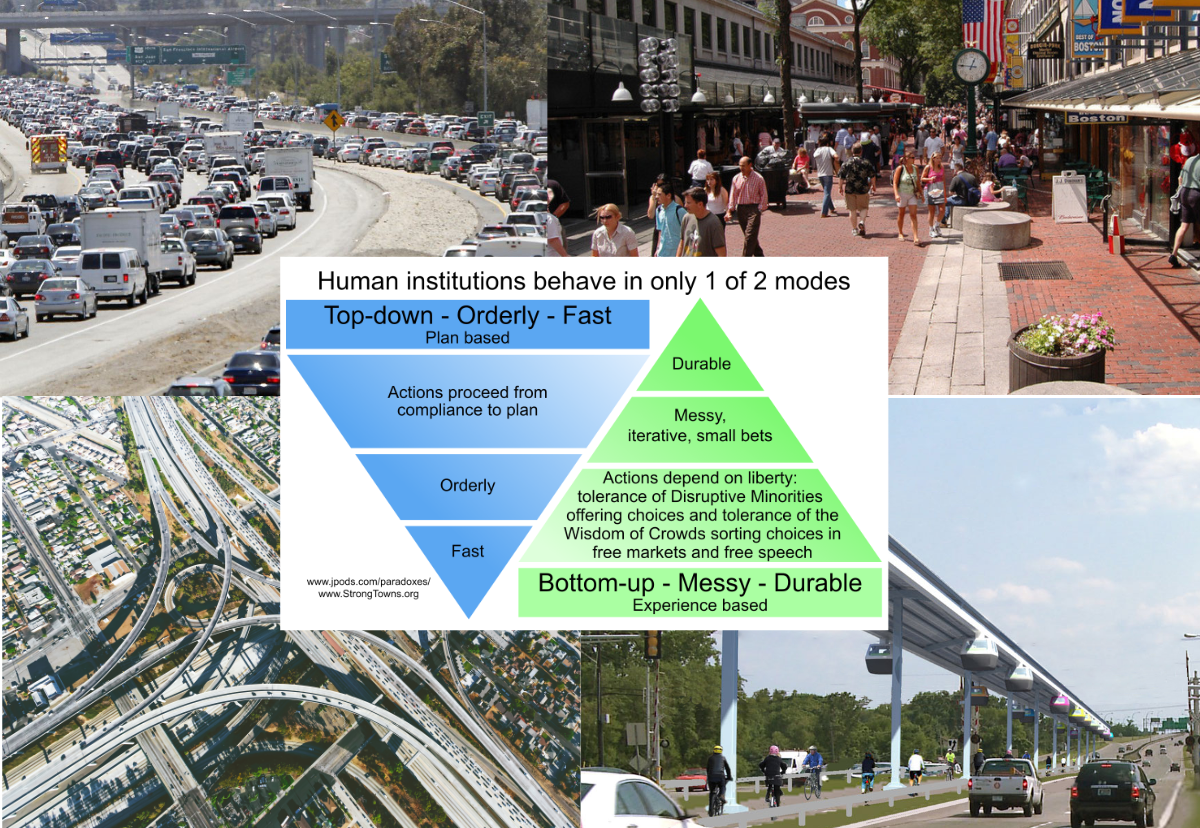
Result of socialized centrally planned infrastructure is rigid, brittle compliance to inefficient methods and a failure to adapt and improve to the point we created Civilization Killers.

Consequence of socialized centrally planned infrastructure is we must either immediately re-tool to reduce watt-hours per passenger mile by 80%, or nature will forcibly reduce the number of passengers by 80%.

Unleashing innovation:
Communications infrastructure was unleashing from central planning and returned to a free market managed by performance standards in 1984. Bell's century old analog technology was replaced with the Internet and cell networks. Millions of jobs and vast wealth created. Performance Standards can repeat that success in power and transportation infrastructure. Germany's Feed-in tariffs (FIT's) have created 250,000 jobs.

The innovations of Ford, Edison, Bell and the Wright Brothers were created in a free market, without having to get permission from a politician or a bureaucrat. If they had to get permission, we would not have those innovations. The pace of central planning can be seen in the 50 years required to go from rotary dial to TouchTone analog phones. In a free market managed by performance standards it took less than 20 years to completely re-tool from analog to digital to wireless infrastructure. Free markets allow niches where innovations can tinker, mature and scale. Free markets allow customers, not policy makers, to decide what best meets their needs and budgets.

Paradigm Shift in Transportation:
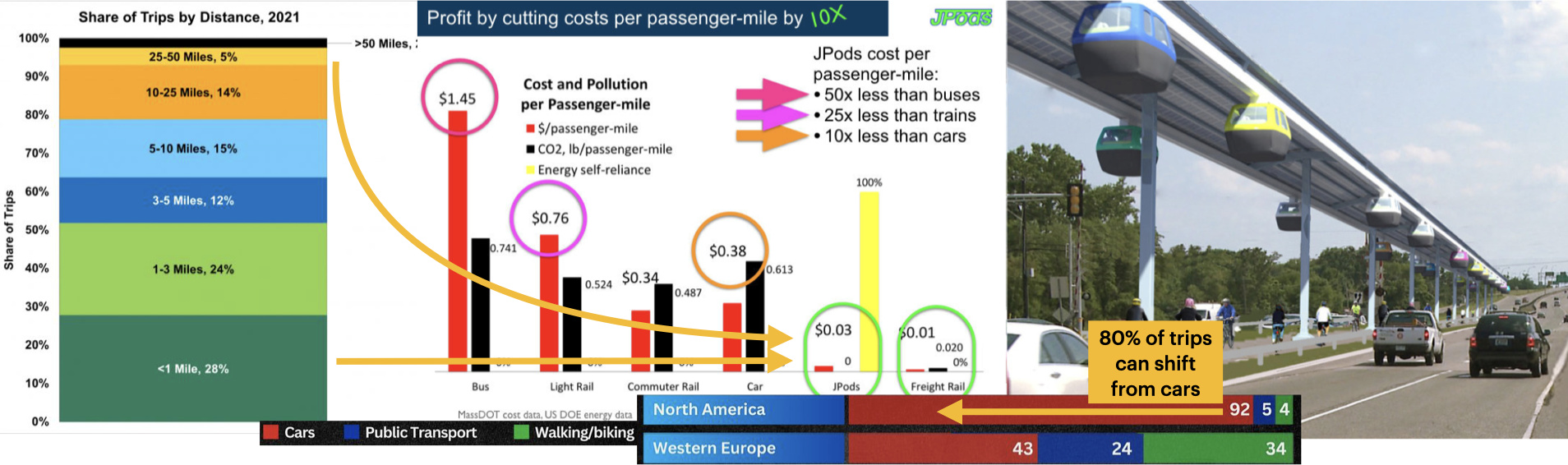
JPods networks are circulatory systems for cities; a Physical-Internet moving people and cargo at 10 times the efficiency of oil-powered transportation.
  • Passion: On-demand personal mobility. Mobility is an aspect of liberty.
  • Objective: Sustainable transportation.
  • Problem: Moving a ton to move a person at 1,000 watt-hours per passenger-mile (bus, car, planes and train).
  • Solution: Move only the person at 130 watt-hours per passenger-mile (JPods, CargoPods, TrashPods).
  • Profits: Convert 85% of energy costs to profit and jobs.
  • Metrics: Profit per passenger mile (value-added), Watt-hours per passenger mile (efficiency), Travel time per mile (convenience).
  • Power source: Solar collectors 2-meters wide mounted over the rails gather 5,000 to 12,000 vehicle miles of power per mile of rail per day. The distributed nature of the transportation network can be used to harvest distributed power sources:
    Thomas Edison, 1910:
    "Sunshine is spread out thin and so is electricity. Perhaps they are the same, Sunshine is a form of energy, and the winds and the tides are manifestations of energy."

    "Do we use them? Oh, no! We burn up wood and coal, as renters burn up the front fence for fuel. We live like squatters, not as if we owned the property."

    "There must surely come a time when heat and power will be stored in unlimited quantities in every community, all gathered by natural forces. Electricity ought to be as cheap as oxygen...."
  • Technology: Personal Rapid Transit (PRT) was deployed at Morgantown WV as a solutions to the 1973 Oil Embargo. That network has delivered 110 million injury-free, oil-free passenger miles. It is the first iteration of what will become a physical version of the Internet; computer networks moving people and goods on-demand.
  • Safety: Morgantown's PRT has operated injury-free since 1975. In that same period highway networks have killed 1.3 million Americans and created an additional economic loss of at least $1.6 trillion. Roller coasters are about 12,000 times safer than highways. Railroads are also safer. Yet over the past century, government central planners incrementally subsidized highways so thousands of miles of railroads were abandoned, lost to service. Only a government monopoly could survive and increase its market share with such a terrible safety record. There was no conspiracy, just good people trying to do a good job as they incrementally more precisely built on what was done by previous experts.
  • US Market Size: $11 trillion over the next 12 years. BHAG timeline is mandated by the current economic collapse. Yes, we know how hard and how much effort will be required. Continued economic collapse is our other choice.
    • Paid for in oil savings every 7-12 years.
  • Side benefits:
    • Create an average of 1.8 million jobs as the infrastructure is built over the next 12 years.
    • Increase working family disposable income by $5,000. Transportation costs drop as access to transport without a car payment increases. Center for Housing Policy study provides data for the first 3 columns. As access to public transportation and taxis increase, costs decrease, disposable income increases. JPods networks will strive for a 70% access for people, hopefully saving a car payment per family per month, accident and congestion costs (4th column).
    • % accessCost per family+ disposable income
      less than 5%$10,300$0
      about 12%$9,300$1,000
      NYC 31%$7,800$2,500
      JPods, 70-80%$5,300$5,000
    • Preempt 85% of Green House Gas by simply not wasting that oil.
    • Tame the price of oil.
    • End trade deficits and strengthen the dollar.
    • Export the technology to the world.
    • Improve service, the convenience of a chauffeured car at the cost of operating an elevator.
    • On-demand personal mobility regardless of age, ability or wealth.
    • Tech stocks will lead a market recovery as we build the Physical-Internet.
  • Reading list to create a common frame of reference of the innovation process and driving a paradigm shift:
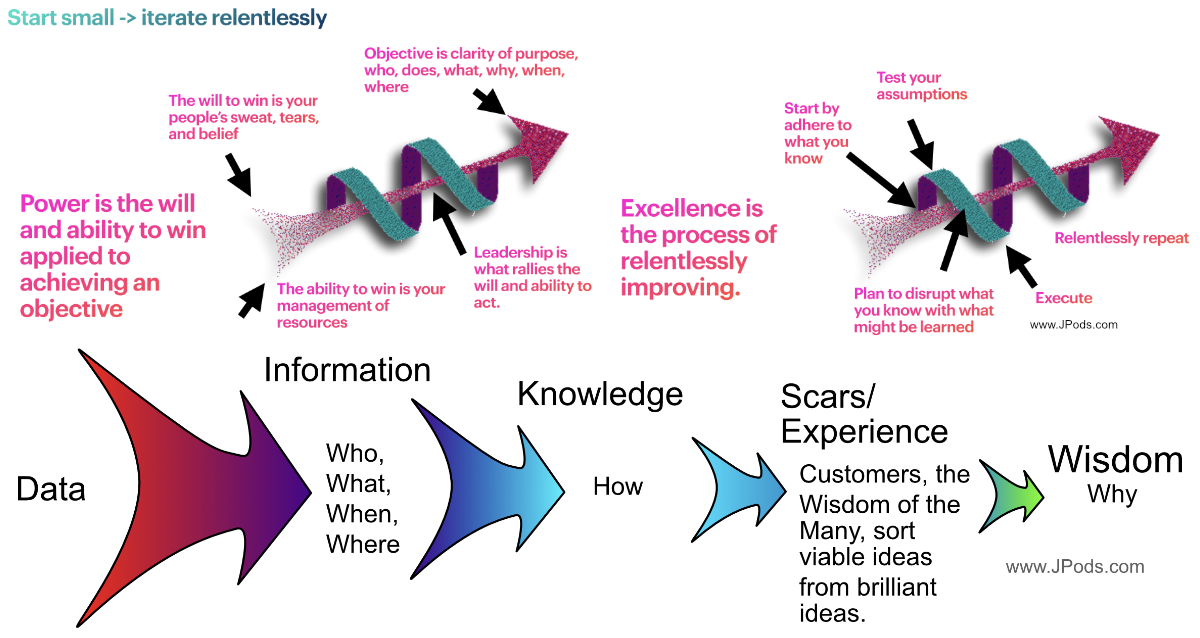
    • Good to Great by Jim Collins, how to change an organization from being good to greatness. The Stockdale paradox of unwavering faith we will prevail while facing the most brutal facts of the current reality. The flywheel principle of incremental, yet relentless improvement.
    • The Black Swan by Nassim Taleb, how to make decisions without being the turkey, dealing with uncertainty. The turkey wakes everyday to kind feeding by humans. Everyday its experience reinforces that life is stable and good; just like oil. "Empty suits" the experts who aren't.
    • The Tipping Point by Malcolm Gladwell, how change happens.
    • Outliers by Malcolm Gladwell, who makes the changes and the decade of preparation required. JPods has our decade of preparation.
    • Nothing Like It in the World by Stephen Ambrose, how the Transcontinental Railroads were built. Private construction capital (risk on the innovators) reinforced by government backed bonds once networks were in operation and achieving public policy objectives.
    • The Wisdom of Crowds by James Surowiecki, on why free markets and democracies work. Specific example for why customers should design where transport systems run instead of experts.
    • Positively Outrageous Service by T. Scott Gross, on why companies that listen to their customers succeed.
    • The Crash Course, Google "Chris Martenson". The course is free on the Internet.
    • Innovate Like Edison by Michael Gelb and Sarah Miller Caldicott, little contrived but great quotes and background on tinkering process of Edison and his team.
    • Einstein and His Universe, institutional resistance to changes from the current "know-how" to a different "know-what". Despite a massive mail campaign seeking a teaching job, took 4+ years after publishing the Special Theory of Relativity and Proof of Quantum Mechanics and proof the atoms and molecules for Einstein to get a teaching job; it is easier to change physics than to change minds.
    • PB-244854, Congressional Office of Technology Assessment study that is a blueprint of oil independent cities, 1975. It also warned "Finally, institutional failures may have hindered implementation."